The Construction of the Great Bridge, Uniting Brooklyn and New York
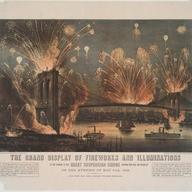
Hailed as “The Eighth Wonder of the World” when it opened in 1883, the Brooklyn Bridge was a feat of civil engineering. Thousands of people made the first public crossing with fanfare and fireworks. The road to completion was not a smooth one for the “East River Bridge,” but the stone and steel that linked Brooklyn and Manhattan foreshadowed the official political union that would later form the five boroughs of Greater New York in 1898.
When this episode of New York: A Portrait in Sound was produced in the 1960s, the bridge had already undergone a redesign to remove its rail and trolley lines. Yet, the episode evokes the transit of the past with the sounds of trolley bells, horse’s hooves and old automobile horns.
Designer John Roebling, impatient with the East River ferry between Manhattan and Brooklyn, envisioned a bridge connecting the two, and in 1866 the New York State Legislature passed a bill granting its construction. On one of the final surveys of the site, a ferry crushed John Roebling’s foot on a Brooklyn pier and he died of tetanus shortly thereafter. His son, Washington Roebling took up the role of chief engineer of the project, but contracted Caisson’s disease, or the “bends,” two years into construction while overseeing the work and was permanently paralyzed.
Washington’s wife, Emily, acted as chief engineer on site in his stead. Regarded as the first female field engineer, Emily began relaying her husband’s instructions and, building upon her own working technical knowledge, she frequently consulted with contractors and assistant engineers on the project. Emily oversaw the construction to the bridge’s completion, and though she was well-respected by the engineers and city officials she worked with, she was granted no official title in relation to the project.


Emily was the first person to cross the completed bridge after 13 years of construction, with a rooster in her lap for good luck. One week later at the bridge’s grand opening, President Chester Arthur and New York Mayor Franklin Edson led the first public crossing from Manhattan to Brooklyn. When they reached the Brooklyn pier, Mayor Edson locked arms with Brooklyn Mayor Seth Low.
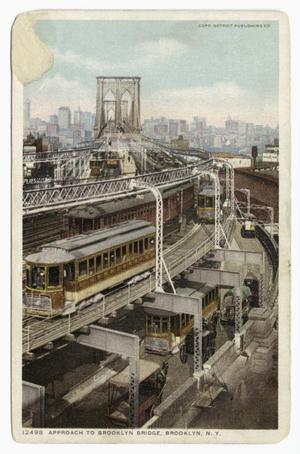
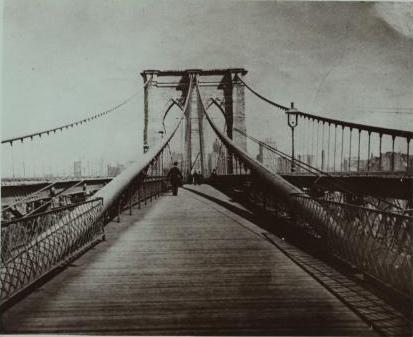
The bridge was originally designed to accommodate three types of traffic. Two railroad tracks made up the center lane; two lanes on either side were intended for horse-drawn carriages; over the railway tracks, an elevated promenade would serve pedestrians and cyclists. Fifteen years after the bridge opened, the City of Brooklyn became one with New York County (Manhattan and Bronx), Queens County and Richmond County to form Greater New York. That same year, the Brooklyn trolley system made its tracks in the bridge’s carriage lanes. Technology was changing fast, however, and by 1903 the first car had made its way across the bridge as well, and automobiles finally usurped the outer lanes, as well as the center railway lane, entirely in the 1950s.

WNYC is funded by sponsors and member donations



