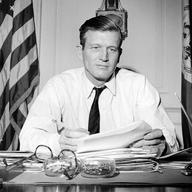
Mayor Lindsay press Conference [on police strike]
Mayor Lindsay press conference on three-day police strike.
The Mayor's statement is as follows:
Eight million New Yorkers depend each day on New York's police to preserve the peace, ensure the,public safety, protect lives and property and aid those in distress.
Our police have performed this highest public service over the years with unparalleled skill, sensitivity and devotion and with the deepest commitment to the laws of this city and to the orderly processes of society.
Today is the third day of a widespread work stoppage by the substantial majority of our patrolmen. The Police Commissioner has reported to me that despite the grave pressures placed upon the Police Department, essential services are being maintained. Last night and today the department was able to maintain almost normal levels of mobilized patrols to respond to emergency calls from the public for assistance.
Detectives, superior officers and some patrolmen are working long emergency shifts to maintain the front line of defense for our city. That is a heavy burden and our city owes the greatest and deepest gratitude for these extraordinary responses.
But this superb performance by several thousand men contrasts sharply with the illegal actions by some 20,000 patrolmen. They are violating the clear law of this city and state. They are defying the discipline of their department and of their oath of office. They are repudiating an order of the court to desist, and they are acting against the interests, needs and safety of the 8,000,000 citizens of this city.
The people of New York City take pride in their police, support them and look to them for leadership. The taxpayers of this city over the years have been generous in their compensation, and they can even understand the deep disappointment of our police in Thursday's decision of the state's highest court in the parity lawsuit.
But New Yorkers cannot condone this repudiation of oath and obligation, which is an attack on the people of this city and on the rule of law itself. Public concern is mounting. The people of New York expect these men to honor the order of the court, return to work and resolve their dispute through the peaceful and orderly processes of collective bargaining.
Early this morning I met with Director of Labor Relations Herbert Haber. At my direction he has now begun round-the-clock negotiations all weekend with the unions representing the three uniformed services on all issues.
The city has reaffirmed its belief that through intensive collective bargaining all issues can be resolved. The public interest requires that this resolution come as rapidly as possible.
* * *
There follows a question and answer period focusing on current crime levels and possible paths to resolution, during which the Mayor repeatedly refers to his original statement. Sample questions:
Q. Mr. Mayor, does the city plan punitive action against those patrolmen who refuse, to perform their customary duties?
A. I don't think that it's useful at this time to make any further comments beyond the statement that I have made.
Q, Mr. Mayor, is there any estimate as to how long the department can continue at this level?
A. Well, that's really a police matter, which I prefer not to comment on. I'm sure the Commissioner would be...
Commissioner Murphy—It's reasonably possible for us to maintain this level of service for another few days at the most. We cannot go on indefinitely because men just cannot continue to work 12-hour tours of duty without days off.
However, in this history of this great department men have worked for very long periods of time without full days off and for 12-hour tours of duty. So I would say that we can go on like this for another few days but not indefinitely.
Q. Commissioner Murphy, can you tell us what happened to the level of reported crime in this city during the last 24 hours?
A. We do not see great variations. However, one of the services that is not being maintained on its usual basis is the crime report processing, so we do have some difficulty in talking with accuracy about this.
However, all of the evidence we have suggests that there have been no dramatic increases in crime. We're close to normal.
Q. What about essential services, emergency services?
A. . . . We are able to man a sufficient number of sector cars, radio motor patrol cars throughout the city to respond to calls coming in over 911, the police emergency communications center. Calls are coming in to the center on the usual schedule. We're able to respond to requests for assistance at approximately the normal level.
Q. Do you have any idea of how much of the patrol force is now on job action? It's estimated that 85 per cent are on it.
A. No, it ranges [from] 75 per cent and upward to the best of our knowledge. However, the men are in the station houses in most places. Most of the men taking job action are in the station houses not performing the usual patrols.
So when you talk about 75 per cent, I'd like to make it clear that we're talking about men not performing their regular duties, but who are available and have been used in a few instances when serious emergencies have occurred.
Q. You mean an emergency like the bombing up in the Bronx?
A. We have been successful in getting the men to respond when directly ordered to serious emergencies. There have been a limited number of those incidents. The night has been a rather normal night. The temperature has been a very low one, a cold night and for that reason, in addition to others, things have been close to normal.
Audio courtesy of the NYC Municipal Archives WNYC Collection
WNYC archives id: 151515
Municipal archives id: T7743



